A protective security specialist sounds like a job title. In practice, it is an operating gap many engineering teams discover only after a compromised workflow, poisoned package, leaked token, or suspicious pull request turns into a production incident.
Teams think the problem is finding more vulnerabilities. The real problem is deciding which signals matter before code merges, who owns the decision, and how the decision becomes a repeatable control inside CI/CD.
That changes the conversation. A protective security specialist is not just a person who says no. In a modern software organization, the role is part architect, part investigator, part automation owner, and part supply-chain risk translator.
The practical question is not whether you need more scanners. You probably already have several. The question is whether anyone is turning scanner output, workflow context, package behavior, and repo ownership into protective action at the right point in the delivery pipeline.
Table of contents
- Why a protective security specialist is an operating role
- The architecture a protective security specialist owns
- CI/CD threats the role must understand
- Supply-chain risk is a workflow problem
- How a protective security specialist designs the PR path
- What works in implementation
- What fails in implementation
- Metrics a protective security specialist should track
- Building the operating model
- Where vu1nz.com fits
Why a protective security specialist is an operating role
The reframe from gatekeeper to system designer
The mistake teams make is treating a protective security specialist as a late-stage reviewer. Someone opens a pull request, the pipeline runs, a scanner complains, and security is pulled in to decide whether the finding is real. That is not protective. That is reactive triage with a nicer title.
A useful way to think about it is this: the role exists to design the path between signal and decision. It asks what should happen when a workflow file changes, when a new package appears, when a GitHub token is over-scoped, when a runner touches untrusted code, or when a maintainer account behaves differently than usual.
If the answer is always manual review, the system will not scale. If the answer is always block, developers will route around it. The role is to build enough context into the delivery path that most decisions are obvious, auditable, and fast.
Practical rule: A protective control is not real until it has an owner, a trigger, a decision, and an exception path.
Why this matters more in 2026
CI/CD is now part of the attack surface, not just part of the release process. GitHub Actions, package registries, build runners, deployment tokens, artifact stores, and AI-generated code all sit between source and production. Attackers do not need to exploit production if they can influence what production receives.
Many teams still organize security around application findings and dependency CVEs. Those matter. But supply-chain incidents often begin in places CVE-driven programs do not see well: install scripts, maintainer compromise, workflow permission changes, malicious postinstall behavior, or a PR that modifies automation rather than application logic.
That changes the conversation. Protective work has to move closer to the merge decision. The right place to catch a risky dependency or unsafe workflow is before it becomes part of the default branch, not after a nightly scan files a ticket.
Where the role sits in engineering
A protective security specialist should sit close enough to platform engineering to influence CI defaults, close enough to AppSec to understand code risk, and close enough to incident response to learn from what actually breaks. In smaller teams, this may be one DevSecOps engineer wearing the hat. In larger teams, it may be a security engineering function with explicit CI/CD ownership.
The role should not become a centralized approval queue. It should publish secure patterns, maintain detection logic, tune blocking rules, review exceptions, and make sure developers can see why a decision happened.
Related reading from our network: teams thinking about SOC ownership can borrow useful workflow ideas from CHP traffic incident thinking for SOC response architecture, especially the focus on routing, responsibility, and response state.
The architecture a protective security specialist owns
Signals are not controls
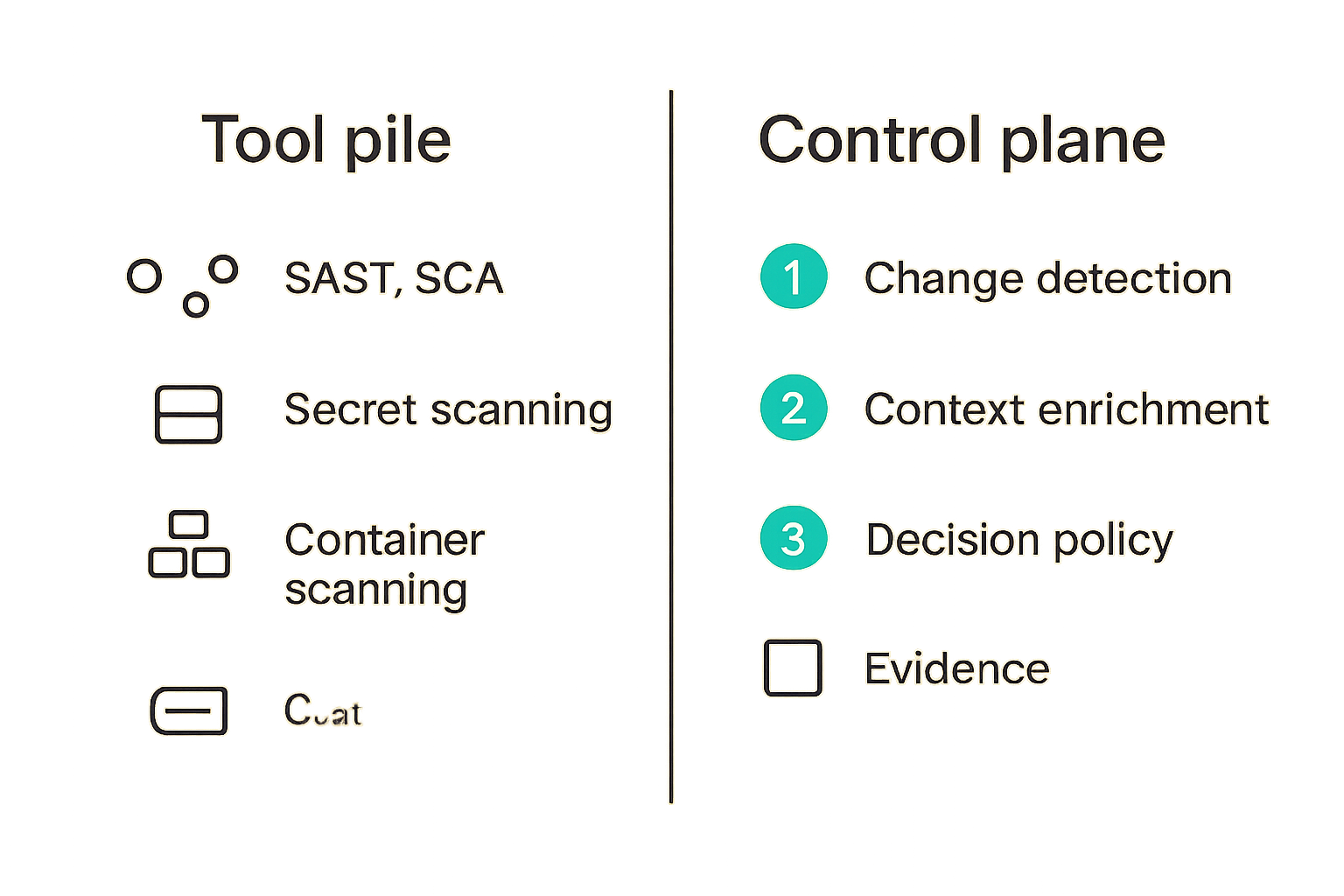
Most organizations have signals everywhere: SAST, SCA, secret scanning, branch protection, container scanning, IaC scanning, SBOM generation, cloud posture findings, runtime alerts, and ticket backlogs. The problem is rarely absence of data. The problem is that signals do not automatically produce protective behavior.
What breaks in practice is the handoff. A scanner posts a comment. The comment is ignored because it is noisy. A ticket is created. The ticket misses release timing. An exception is approved in chat and never recorded. Two months later, nobody knows why the risky pattern was allowed.
The protective security specialist owns the architecture that closes that gap. The point is not to admire findings. The point is to define which findings are advisory, which require owner review, which block merge, and which trigger incident response.
The control plane view
A practical control plane for CI/CD and supply-chain security has five parts:
- Change detection: what changed in the PR, including workflows, dependencies, lockfiles, build scripts, permissions, and deployment definitions.
- Context enrichment: repo criticality, package ecosystem, maintainer trust, runner type, token scope, release path, and service ownership.
- Decision policy: allow, warn, require review, block, or escalate.
- Evidence capture: comments, artifacts, logs, SARIF, approval records, and exception metadata.
- Feedback loop: tuning rules based on false positives, incidents, bypasses, and developer friction.
This is architecture work. The UI may be a GitHub check, but the system is really state, ownership, and policy.
A comparison of weak and strong models
| Area | Weak model | Strong model |
|---|---|---|
| Scanner output | Posted as generic comments | Mapped to allow, warn, review, or block |
| Workflow changes | Treated like normal code | Classified as CI/CD control-plane changes |
| Dependency additions | Checked for known CVEs only | Reviewed for provenance, behavior, and ecosystem risk |
| Exceptions | Approved in chat | Time-bound, recorded, and visible in PR context |
| Ownership | Security team as ticket queue | Repo owners plus security-defined guardrails |
| Metrics | Count of findings | Decision latency, bypasses, repeat patterns |
Practical rule: If a control cannot explain why it blocked or allowed a change, it will either be ignored or disabled.
CI/CD threats the role must understand
Workflow injection and permission drift
GitHub Actions security is full of small defaults that become large blast radius problems. A workflow may run on unsafe events, pass attacker-controlled input into shell commands, use broad repository permissions, or rely on mutable third-party actions. None of these need to look dramatic in a diff.
A protective security specialist should treat workflow files as privileged code. Changes to .github/workflows are not just build maintenance. They can alter who gets code execution, what token scopes are available, which secrets can be reached, and what artifacts are published.
The practical question is: when a workflow changes, does the PR path know that the risk class changed? If not, a normal review process may miss the most important part of the diff.
Untrusted code in trusted runners
CI is designed to execute code. That is exactly why attackers like it. Pull requests from forks, dependency scripts, test harnesses, build plugins, and generated code can all execute inside environments that developers treat as routine.
Self-hosted runners raise the stakes. They may have network access, cached credentials, local artifacts, or paths into internal infrastructure. A workflow that is safe on an ephemeral hosted runner may be unacceptable on a long-lived self-hosted runner.
The role must define runner trust boundaries: what can run where, which events can access secrets, when caches are safe, and how artifacts move between untrusted and trusted stages.
Secrets, tokens, and environment boundaries
Most CI/CD failures are not just code execution. They are code execution plus a credential. A leaked npm token, over-scoped GitHub token, cloud deployment key, signing certificate, or package publishing secret turns a pipeline issue into a supply-chain event.
The mistake teams make is scanning for secrets but not modeling secret reachability. A token in a protected environment is different from a token available to pull request code. A deployment secret exposed only after manual approval is different from a registry token available during install.
Protective work means reducing credential exposure by default and making privilege escalation visible when the pipeline changes.
Supply-chain risk is a workflow problem
New dependency is not the same as safe dependency
A dependency can be new, popular, and dangerous. A package can have no CVE and still exfiltrate tokens in a postinstall script. A maintainer account can be compromised. A package can be replaced through dependency confusion, typosquatting, protestware, or malicious maintainer transfer.
The protective security specialist should make dependency additions first-class review events. That does not mean every package requires a security meeting. It means the PR path should know when a new npm, pip, cargo, gem, Go, or Composer package appears, what ecosystem it belongs to, and whether behavior deserves closer inspection.
For a concrete set of cases where CVE-first dependency programs miss the real attack, see our breakdown of what Dependabot misses in npm supply-chain attacks.
Malware behavior beats CVE-only thinking
CVE databases are useful for known vulnerable versions. They are not a complete model for malicious packages. Malware often appears before public advisories, and in some ecosystems the first useful signal is behavior: network calls during install, credential harvesting, obfuscated scripts, suspicious publish history, or unexpected binary downloads.
This is where protective security becomes operational. The role must decide which package behaviors block automatically, which require review, and which are allowed with evidence. It also needs to separate ecosystem-specific norms from actual risk. A binary download may be normal for one package class and suspicious for another.
Ownership matters during dependency review
Dependency review fails when nobody owns the business context. Security can identify suspicious behavior, but the service owner knows whether the package is necessary, whether there is an alternative, and whether the release can wait.
A workable model routes dependency questions to the repo owner, adds security context, and records the outcome. If the package is allowed, the reason should survive the PR. If it is blocked, the developer should get a clear remediation path.
Related reading from our network: privacy teams face a similar context problem when choosing secure messaging controls; the useful part is not the chat UI but the workflow around devices, retention, and validation in secure messaging apps in 2026.
How a protective security specialist designs the PR path
Classify the change before scanning it
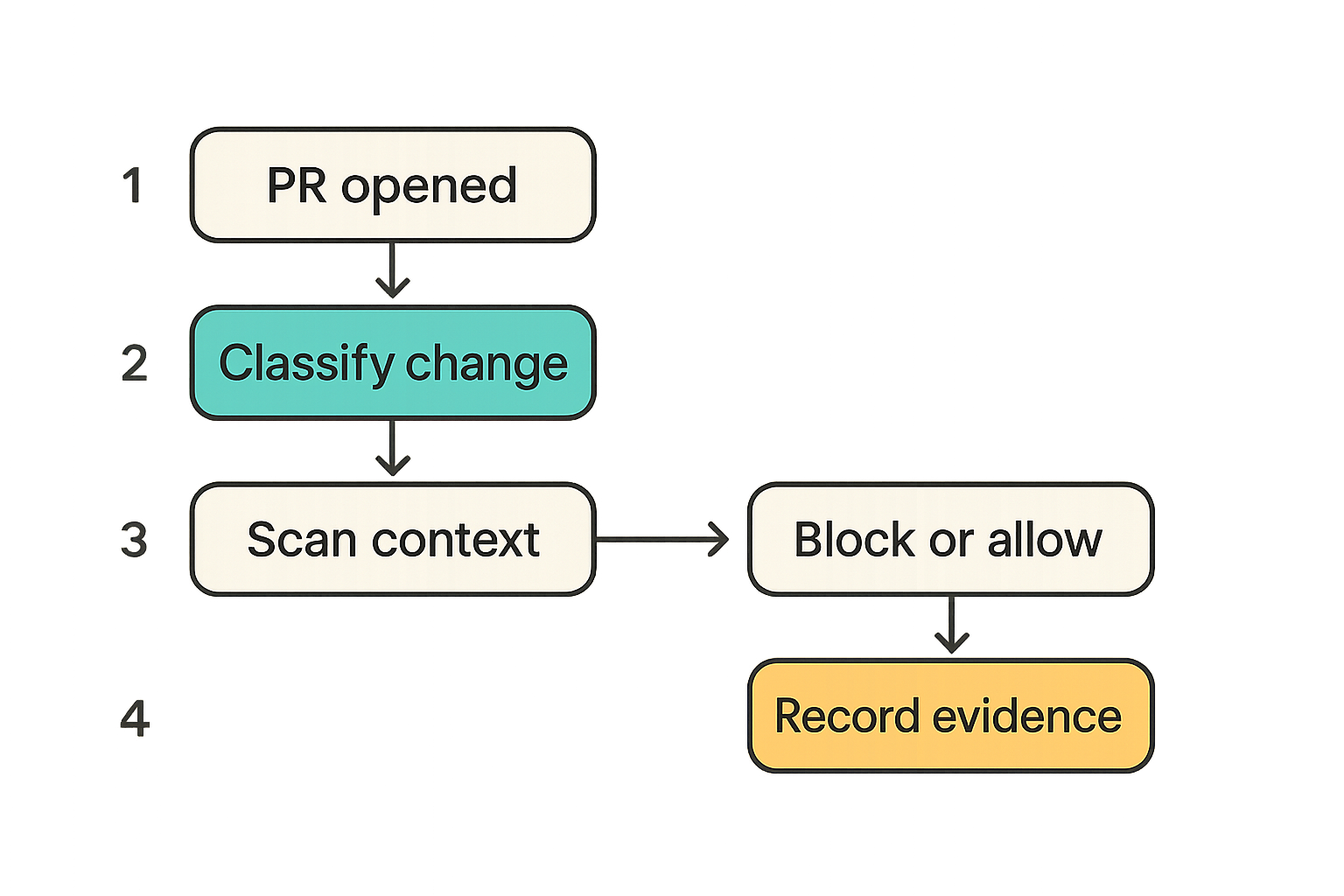
The PR path should classify risk before it applies generic checks. A documentation edit, a dependency addition, a workflow permission change, and a deployment manifest update should not receive the same treatment.
A simple classification sequence works well:
- Detect changed files and manifests.
- Identify whether the change affects CI/CD, dependencies, secrets, infrastructure, or release logic.
- Attach repo and service criticality.
- Run targeted checks for the risk class.
- Decide allow, warn, require owner review, block, or escalate.
- Record the decision in the PR.
The point is to avoid making developers parse irrelevant noise. A package malware signal belongs near dependency diffs. A workflow permission warning belongs near the workflow file change. A deployment credential issue belongs near release logic.
Use policy gates sparingly but precisely
Blocking is expensive when it is vague. It is cheap when it is obvious. A good protective security specialist defines a small number of high-confidence gates and keeps lower-confidence findings advisory until they prove their value.
Examples of reasonable block candidates include newly added packages with clear credential exfiltration behavior, workflows that expose secrets to untrusted pull request code, use of mutable third-party actions in privileged release paths, or changes that grant broad write permissions without owner approval.
Practical rule: Block on high-confidence exploitability, not on generic discomfort. Everything else needs context, ownership, or evidence.
Keep evidence with the pull request
Security decisions decay when evidence lives outside the change. If approval is in Slack, scan artifacts are in a separate console, and the exception is in a spreadsheet, nobody can reconstruct what happened.
A protective PR path keeps key evidence near the code review. That can include a concise check summary, links to artifacts, rule identifiers, package behavior notes, reviewer identity, and exception expiration. The PR becomes the audit trail.
The mistake teams make is optimizing for scanner dashboards while developers live in pull requests. Put the decision where the merge happens.
What works in implementation
Start with high-leverage repositories
Do not begin by trying to cover every repo equally. Start with repositories that publish packages, deploy production services, handle credentials, build artifacts consumed by other systems, or control shared CI templates. These repositories create downstream risk.
A useful rollout order is:
- Release and deployment repositories.
- Shared CI/CD templates and reusable workflows.
- Package publishing repos.
- Core application services.
- Internal libraries and lower-risk services.
This gives the protective security specialist early signal on the paths where compromise matters most.
Make security results developer-native
Developers should not need to become security console operators to understand why a PR is blocked. Results should be short, specific, and actionable. Bad: suspicious package. Better: new npm package runs postinstall script that reads environment variables and opens outbound network connection during installation.
Developer-native also means stable rule IDs, clear remediation, and examples. If the rule says pin third-party actions by SHA, show the expected pattern. If the rule says avoid pull_request_target for untrusted code, explain the safer workflow split.
The vu1nz GitHub Action is designed for this kind of PR-native control path: one workflow can scan CI/CD configuration and newly added packages without forcing engineers into a separate review surface, as described in the vu1nz GitHub Action for CI/CD and package security scanning.
Automate the boring decision paths
The goal is not to remove humans. The goal is to use humans where context matters. Routine safe cases should pass. Known-dangerous cases should block. Ambiguous cases should route to the right owner with enough detail to decide quickly.
Good automation reduces both noise and latency. It also gives the protective security specialist time to improve rules, investigate weird patterns, and validate controls against real attack techniques.
Related reading from our network: infrastructure teams comparing platforms face a similar architecture-versus-dashboard trap, which is why this cloud computing companies architecture guide is relevant even outside security.
What fails in implementation
Tool sprawl without ownership
The most common failure mode is buying more tools without assigning control ownership. One scanner comments on dependencies. Another opens issues. Another posts SARIF. Another sends alerts to Slack. Nobody knows which one decides merge eligibility.
What breaks in practice is trust. Developers see inconsistent findings and learn which ones can be ignored. Security sees ignored findings and adds more alerts. The loop gets worse.
The fix is not fewer tools by default. The fix is a clear control contract: which signals matter, where they appear, who owns them, and what action they trigger.
Blocking without context
A block that does not explain itself becomes a productivity incident. If every new package blocks, teams will pressure leadership for bypasses. If every workflow warning blocks, platform engineers will disable the check during urgent releases.
Blocking should be tied to risk class and confidence. A privileged workflow change in a release repo deserves more friction than a low-risk test dependency in an internal tool. The protective security specialist should encode that difference.
Treating CI as a safe execution zone
Many teams still assume CI is safe because it is internal. That assumption is wrong. CI regularly executes untrusted code, downloads third-party packages, evaluates scripts, expands variables, and moves artifacts.
The safe model is staged execution. Untrusted code runs without secrets. Trusted deployment steps require protected branches, approvals, and restricted inputs. Package installation is treated as execution, not as passive download.
If your pipeline cannot distinguish those states, it is not a protective system. It is a build system with secrets attached.
Metrics a protective security specialist should track
Measure decision latency
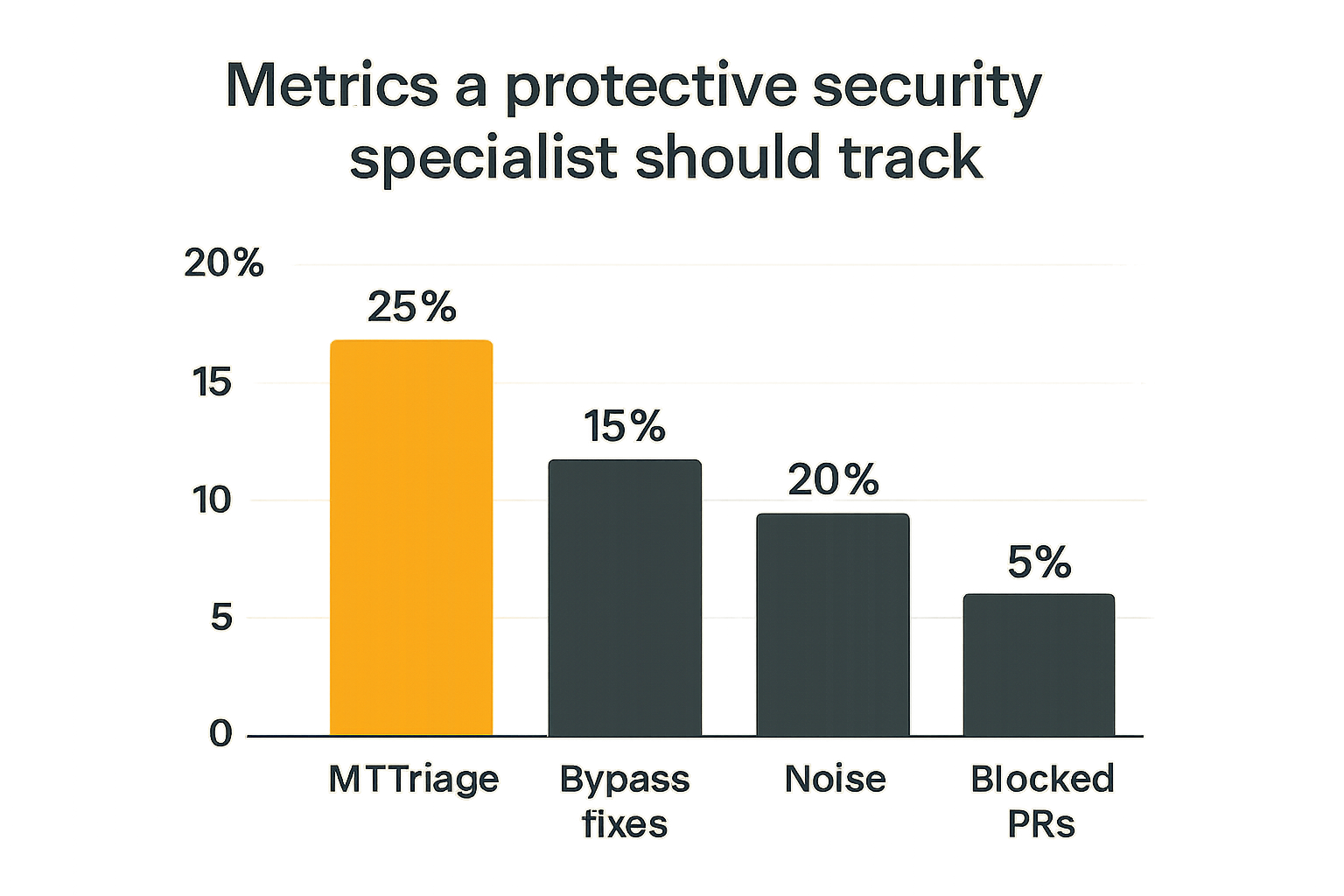
Counting findings is easy and often misleading. A better metric is decision latency: how long it takes from risky change detection to allow, block, review, or escalation.
Long latency means developers wait, security reviews pile up, and releases accumulate informal bypass pressure. Short latency means the control path is understandable and integrated. The target is not zero. The target is predictable.
Track latency by risk class: dependency additions, workflow changes, secret exposure, runner configuration, deployment logic, and package publishing. Each class has different owners and review depth.
Measure bypass pressure
Bypasses are not always bad. Emergency exceptions exist for a reason. But bypass pressure tells you where controls are misaligned with engineering reality.
Track who requested the bypass, what rule was bypassed, which repo was affected, why it was approved, and when it expires. Repeated bypasses for the same rule usually mean one of three things: the rule is noisy, the safe path is too hard, or the organization accepts more risk than the policy admits.
That changes the conversation from arguing about one PR to fixing the system.
Measure repeat findings
Repeat findings are design feedback. If teams repeatedly add unsafe workflow permissions, you may need better templates. If developers repeatedly add packages with install-time network behavior, you may need ecosystem guidance or approved alternatives. If secrets keep appearing in CI variables, environment boundaries may be unclear.
The protective security specialist should convert repeat findings into defaults, education, or automation. Otherwise, the team is paying manual review cost for a pattern the system could prevent.
Building the operating model
Define ownership before alerts
Before adding another check, define who owns the result. A workflow permission issue may belong to platform engineering. A malicious package suspicion may belong to AppSec plus service owner. A deployment token exposure may require security engineering and infrastructure. A package publishing anomaly may involve release engineering.
Ownership should be visible in the workflow. CODEOWNERS, team mappings, repo metadata, and service catalogs are not bureaucracy when they route decisions correctly.
Practical rule: Every alert class needs a primary owner, a backup owner, and a maximum acceptable decision time.
Separate advisory findings from blocking findings
Not every useful finding should block. Advisory findings teach, trend, and inform future tuning. Blocking findings enforce risk boundaries. Mixing the two creates resentment.
A good pattern is to start new rules in advisory mode, measure false positives and developer response, then promote only high-confidence cases to blocking. For severe classes, start blocking immediately but keep the rule narrow.
This also helps security researchers. New detection logic can be tested against real PRs without instantly becoming a release bottleneck.
Run validation drills
Protective systems need validation. Run drills that simulate realistic supply-chain and CI/CD attacks: unsafe pull_request_target usage, malicious package install behavior, over-scoped GITHUB_TOKEN permissions, unpinned third-party actions, suspicious lockfile changes, or secrets exposed to untrusted jobs.
The drill should answer operational questions: Did the signal fire? Did it appear in the PR? Was the owner correct? Did the decision happen quickly? Was evidence retained? Did anyone bypass the control? Did the finding map to a real remediation?
For teams publishing public research, advisories and proofs of concept are also useful feedback loops. We avoid hand-wavy claims in favor of reproducible findings, and the same standard should apply internally.
Where vu1nz.com fits
Use scanners as control inputs
A protective security specialist should not worship scanners, but should absolutely use them. The right scanner becomes an input into the control plane: classify the change, inspect the risky surface, produce evidence, and support a decision before merge.
vu1nz.com focuses on CI/CD and package supply-chain attacks because those are the paths traditional AppSec tooling often handles poorly. CodeQL, Dependabot, and SCA tools have value, but they are not the whole system. You still need workflow-specific checks, package behavior analysis, and PR-native feedback.
Keep the role architectural
The best use of tooling is to make the protective role more architectural, not more manual. The specialist should be tuning policies, reviewing exceptions, investigating novel techniques, and improving secure defaults. They should not spend the day copy-pasting scanner output into tickets.
If your current process cannot answer whether a new package, workflow edit, or permission change should block a PR, the issue is not just tool coverage. It is the missing operating model around protective security.
A protective security specialist gives that model a clear owner. The scanners provide signals. The CI/CD platform provides enforcement. The PR provides evidence. The engineering organization provides context. Put those together and protective security becomes a delivery workflow, not a slogan.
Try vu1nz.com
vu1nz.com is for security engineers and DevSecOps teams who need to defend CI/CD pipelines and software supply chains from modern attacks. Try vu1nz.com and turn protective security specialist work into PR-native controls before risky changes merge.
Catch the next supply-chain attack on the PR that adds it.
14-day free trial · no card required